


PEANUTS
India is one of the largest producer of peanuts in the world. Indian peanuts are available in different varieties: Bolds or Runners, Javas or Spanish and Red Natals; and have a rich nutty flavour, sweet taste, crunchy texture and a relatively longer shelf life.
Peanuts in India are available throughout the year due to a two-crop cycle harvested in March and October. On an average, India produces 7- 8 million tonnes of peanuts (unshelled) every year. In fact, considering the current export figures, India has a much larger potential to supply high quality groundnuts to the international buyer.
The awareness and concern for quality amongst the Indian peanut shellers and processors are growing steadily. Multiple sorting and grading are fast becoming a norm. Indian shippers have the capability to prepare and supply edible peanuts conforming to highest standards.
Peanut in Shell
The Peanut consists of an external hull (or shell) (21-29%) surrounding the nut (79-71%). Peanut hulls, not to be confounded with peanut skins (which are the thin paper-like seed coats enclosing the kernel), are a by-product of peanut processing. The shelling of peanuts is often the second operation (after cleaning) of peanut processing, as both the production of peanut oil and the production of peanut snacks, peanut butter and other peanut-based foods require kernels without hulls (except the production of in-shell peanuts). Peanut hulls usually consist of fragmented hulls with variable amounts of whole or broken kernels.

Varieties of Peanuts
The 2 major varieties of Peanuts produced in India are Bold (runners) and Java (Spanish). The Bold variety peanuts have typically reddish brown skin with oblong shape, while Java variety have pink skin with spherical in shape.
Bold peanuts are the major oilseed of India. It accounts for around 25% of the total oilseed production of the country. Annual production of India Peanuts and Indian Peanuts oil are around 5-8mln and 1.5mln tons respectively.

BOLD
JAVA
RED SKIN JAVA
Blanched Peanuts
Many nuts like almonds, peanuts or hazelnuts are grown in a shell. When the shell is removed there is still a skin on the outside of the nutmeat. Blanching is a process that removes the skin from the nut meat.
So how do you blanch a nut? The process itself is done by putting the nuts in very hot water for about a minute (blanching) then cooling them rapidly and rubbing off the skin.
Well, neither… it just depend what you plan on doing, cooking or snacking on the nuts. Blanched nuts are used mostly for cooking and baking. If the nut is unblanched and the skin is still on, the skin will separate during cooking. Leaving your baked goodie, a husky mess.
But, for snacking nothing beats an unblanched nut. The husk adds just a touch of flavor, and is packed full of nutrients.
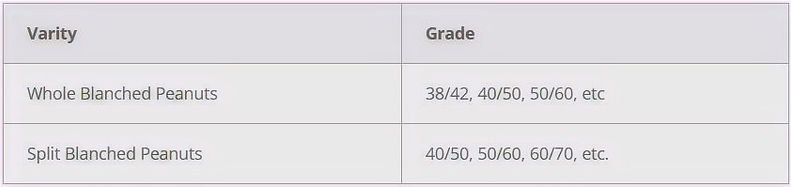
WHOLE BLANCHED
SPLIT BLANCHED
Common Packing For Container Shipment

Benefits of Peanut Consumption
Peanuts are rich in nutrients,providing over 30 essential nutrients & phytonutrients. Peanuts are a good source of niacin, folate, fiber,magnesium,Vitamin E, Manganese & phosphorous. They also are naturally free of trans-fats and sodium and contain about 25% protein.
Peanuts are processed in various forms as Peanut butter/Flavoured peanuts/Coated peanuts/ Peanut bars/Chocolate spreads, nut biscuits, crushed nuts used on cakes, buns, icecream and desserts.
Innovation on use of peanuts in processed foods continues due to its excellent nutritional values.
Facts on Almond Nuts
The almond (Prunus dulcis, syn. Prunus amygdalus) is a species of tree native to the Middle East, the Indian subcontinent and North Africa.
“Almond” is also the name of the edible and widely cultivated seed of this tree. Within the genus Prunes’, it is classified with the peach in the subgenus Amygdales, distinguished from the other subgenera by corrugations on the shell (endocarp) surrounding the seed.
The fruit of the almond is a drupe, consisting of an outer hull and a hard shell with the seed, which is not a true nut, inside. Shelling almonds refers to removing the shell to reveal the seed. Almonds are sold shelled or unshelled. Blanched almonds are shelled almonds that have been treated with hot water to soften the seed coat, which is then removed to reveal the white embryo